People just want answers
Our managers don't want to click through five dashboards. They want to ask what happened to margin in Germany and get a straight answer.
I build conversational analytics for teams that want to ask their data questions in plain English: ask about sales, receivables or margin and get the number, a short explanation and the chart behind it. The assistant sits on a clean data model with defined metrics, so its answers come from the same figures as your reports. You tell me who will use it and what they ask, and I shape it to that.
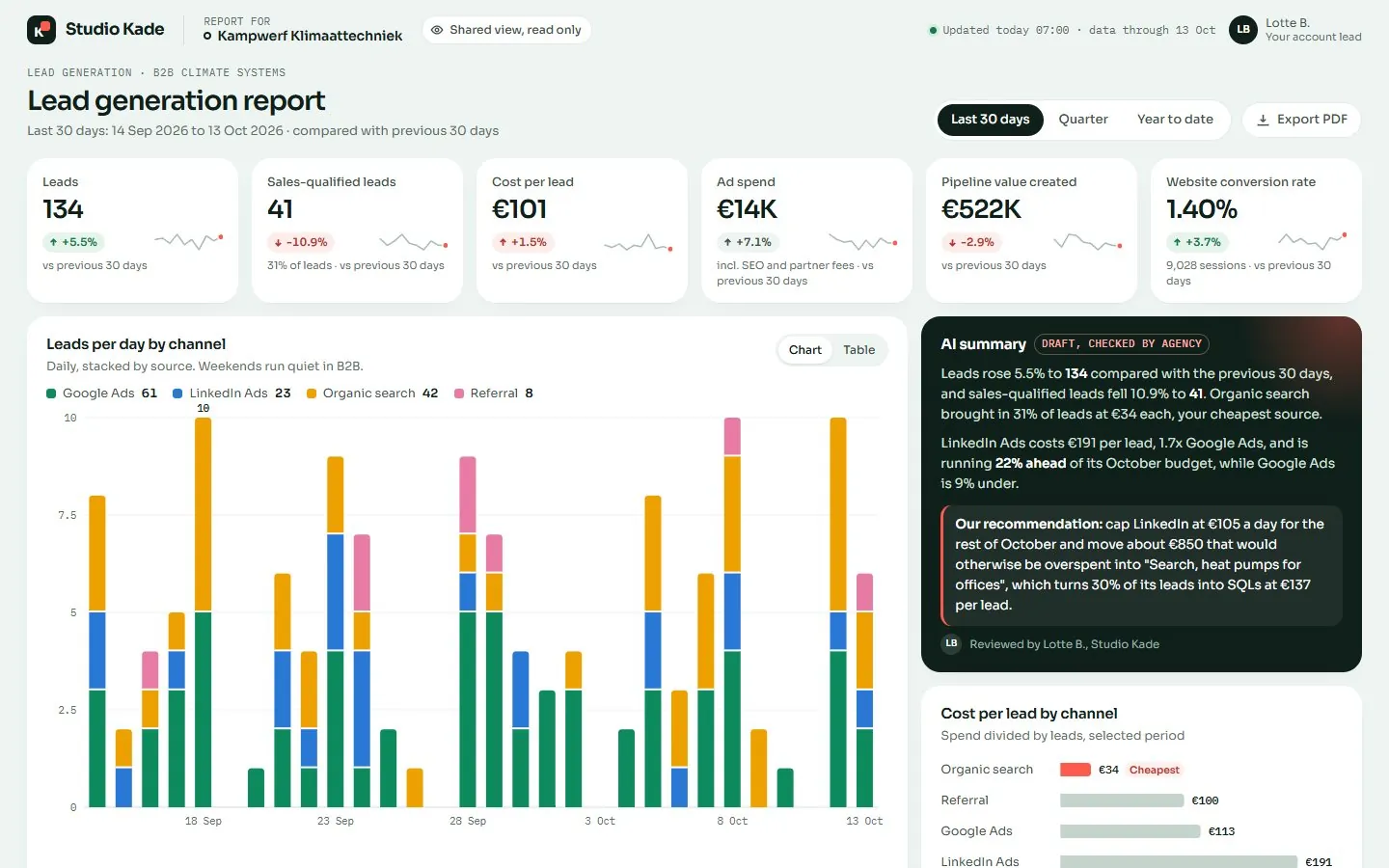 A concept client portal on sample data where a marketing agency shares a live lead report with its B2B client, including an AI summary, the kind of place a chat assistant can sit.
Our managers don't want to click through five dashboards. They want to ask what happened to margin in Germany and get a straight answer.
Management told us to use Copilot. It gave a confident wrong number in the first demo and nobody has trusted it since.
Measures have cryptic names, three tables mean the same thing and only one analyst knows which is right. An AI can't fix that on its own.
A starting point, never a fixed package: describe how you want it and I build it to match.
Microsoft is retiring the older Q&A feature in Power BI in December 2026 and points people to Copilot instead. Copilot needs a Fabric capacity on top of your normal licences, and Microsoft itself says its output can vary even after the data is prepared. In practice the answer quality depends far more on the semantic model than on the AI: a measure called Measure 7 or three date tables will confuse it every time.
So the first part of any natural language query project is model work, the same work an AI-readiness assessment covers. Clear names, descriptions, synonyms, one date table, measures for every number people ask about and a few written instructions on how your business defines things. I'm a Microsoft Certified Power BI Data Analyst (PL-300) with 5+ years as a Power BI data and business analyst, and this model work is a large part of that job.
Narrow assistants are much easier to get right than broad ones. An assistant that only knows your sales data, with defined metrics and tested questions, gives answers you can check. One pointed at the whole data warehouse will answer anything, confidently, and some of it will be wrong.
I'd rather ship one assistant your managers trust than five they ignore. When the first is working we add the next dataset, with its own definitions and test set.
Outside Power BI, a custom chat usually works by text to SQL: the model turns the question into a query, the query runs against a read-only view with your permissions applied, and the AI describes the result. I limit it to approved tables and measures, and every answer shows the query it ran. That answers routine questions quickly, though it can't tell you why a number moved when the reason sits outside the data.
On data privacy: a Copilot or Fabric setup runs under your own Microsoft tenant and agreement. For a custom chat I use EU regions where the provider offers them, and I sign an NDA and DPA on request.
We start narrow: sales, receivables or pipeline, plus the 20 or 30 questions people actually ask about it.
I clean names, measures and relationships and write the metric definitions. Often this step alone improves Copilot a lot.
I set up the assistant and run the test questions, fixing the model until the answers match the known results.
A few users try it first. Their questions become new test cases before more people or datasets are added.
The quote depends on how ready your data model is, how many datasets the assistant should cover and whether it runs as Power BI Copilot, a Fabric data agent or a custom chat inside your own portal.
The client reviews on this site are about data and dashboard work. For this service, here is work you can open and judge yourself, each labelled for what it is.
A monthly pack for a made-up retailer, showing the layout, the data checks and the summary style. On that page the summary is generated in your browser from the sample numbers, not by a live AI model.
Open the exampleA stock analysis platform I designed, built and run myself: the interface, the web app and the data pipelines behind it, with scheduled refreshes.
Live dashboards for fictional companies, built by me on sample data to show what a finished build looks and feels like.
Browse the examplesAnything else? Ask me directly, I reply within a few hours on working days.
Conversational analytics means asking questions about your business data in plain language and getting an answer back, instead of building a report or writing a query. You type something like "which customers bought less this quarter than last" and the assistant returns the number, a short explanation and a chart. It only works well when the data underneath has clear, agreed definitions, which is where most of my work goes.
Power BI Copilot is enough for many teams already on Power BI, provided the semantic model is prepared for it. Copilot needs a Fabric capacity on top of your existing licences. A custom assistant makes more sense when the users have no Power BI licence, when clients need to ask questions inside a portal, or when the data lives outside Power BI. I'll recommend one route in the quote.
The main defence is a clean model with defined metrics, so the assistant picks the right measure instead of guessing. On top of that, every answer shows the measure, filters and period it used, the scope is kept narrow, and a test set of real questions with known answers is run before launch and after every change. Questions outside the scope get a polite refusal instead of an invented number.
Partly. It handles the routine questions an analyst gets every week, such as totals, trends and comparisons on defined metrics, and it shows how it reached each answer. It does not know why a number moved when the reason sits outside the data, and it refuses questions outside its scope. The practical result is that your analyst spends less time on lookups and more on the questions that need judgement.
Yes, the assistant is shaped to your data, your users and the questions they actually ask. Describe in your own words who should use it, what they want to know and where they should find it, and I match that as closely as possible. If a question can't be answered reliably with the current data, I tell you and say what would fix it.
No, the assistant follows the same permissions as your reports. In Power BI and Fabric, row-level security applies to Copilot and data agents, so a regional manager only gets answers about their region. In a custom build I enforce the same rules in the database query before the AI sees any data, so a clever question cannot get around them.
With a custom chat, yes: the question and the query results go to an API provider. With Copilot or a Fabric data agent, processing runs under your own Microsoft tenant and your existing agreement with Microsoft. For custom builds I use EU regions where the provider offers them and API terms that exclude training where that option exists, and only the rows needed for the answer are sent. NDA and DPA on request.
A conversational analytics assistant is priced as a custom quote because most of the work depends on your current data model. If your Power BI model is already clean, setting up Copilot or a data agent is fairly quick. If the model needs restructuring first, that part takes longer and is often the most valuable piece. You get a fixed price before work starts.
An AI readiness assessment from me checks whether your data and BI layer is ready for Copilot, data agents and other AI tools that read it: the Power BI semantic model, the DAX, naming, definitions, data quality and security.
from €250 · Learn more AI automationAutomated reporting with AI commentary, built around your numbersI build automated reporting that puts your monthly or weekly pack together on its own: figures pulled from your systems, checked, charted and sent with a short commentary drafted by AI.
from €1,500 · Learn more Websites & UI/UXCustom web app development services for client portals and data appsMy custom web app development services cover the logged-in tools B2B firms build around their own data: client portals, customer portals and internal apps.
Custom quote · Learn more